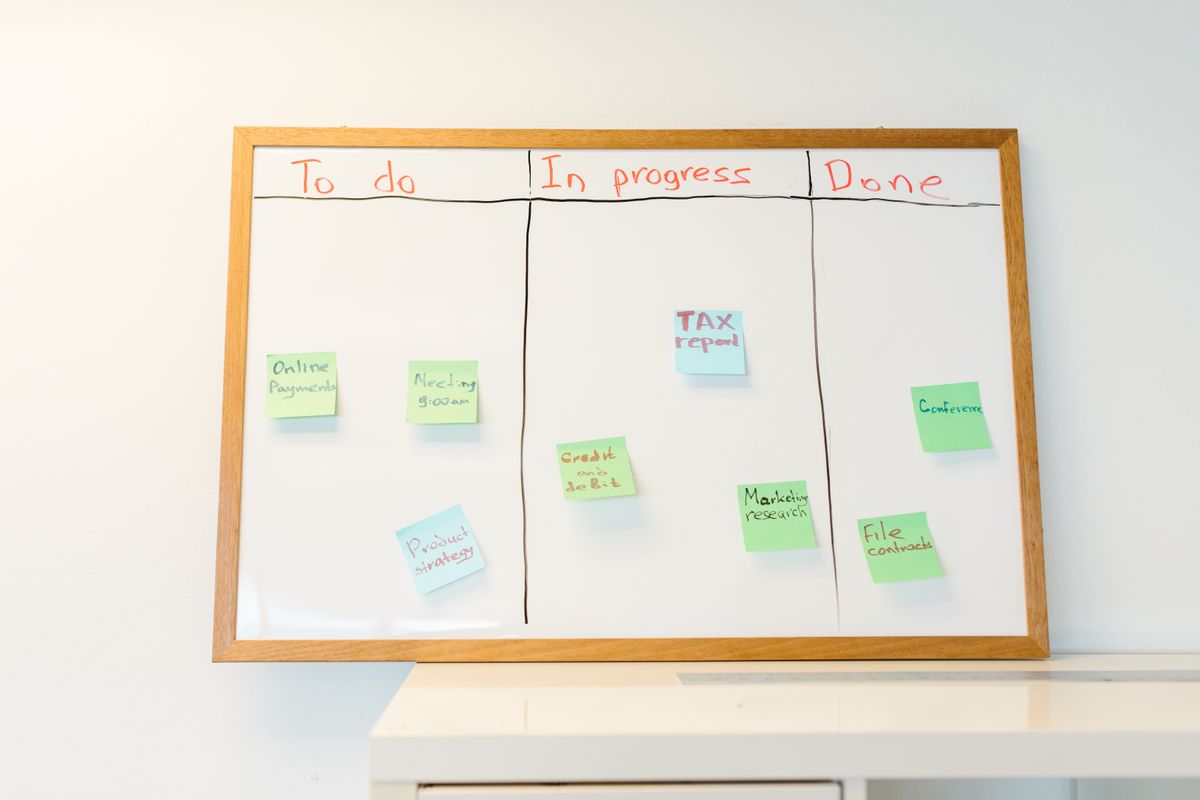
A whiteboard for sketching a process with three people has a different job from a board that holds one person's weekly reminders. The first needs enough space and visibility for a shared discussion. The second needs to be convenient to update without dominating the room. Decide what will be written before measuring the wall.
Write a sample of the information on paper at the size you expect to use. A weekly schedule with seven columns, names and short notes consumes more space than its blank grid suggests. A board that is just large enough for the headings leaves no room for the work itself. Conversely, a large board may encourage spreading a simple list across an awkward area you cannot comfortably reach.
Stand where readers will actually be. Look at the intended wall from the desk, the doorway and any seats used for meetings. Windows and ceiling lights can create reflections that are not obvious while standing directly in front of the board. Check the proposed height as well: the top section should not require constant stretching, and the bottom should remain usable rather than becoming a permanent blank strip.
Surface choice follows frequency of use
Melamine, painted steel, porcelain and glass boards have different constructions and care needs. Manufacturer guidance can help compare intended frequency of use and cleaning requirements. A board used briefly for personal reminders is a different purchase from one that will be written on, erased and rewritten throughout each working day.
Do not assume that every board is magnetic. Check that feature explicitly if magnets are part of the plan. Glass boards, in particular, may require compatible stronger magnets when they offer magnetic use. Also check the marker recommendation: a marker that gives a clear line on one surface may look faint on another.
Try the writing and erasing experience if a sample is available. The useful test includes marks left for a realistic period, not only ink erased seconds after it was applied. Follow the maker's cleaning instructions and use compatible cleaning products. Abrasive pads or improvised chemicals can damage a surface whose smoothness is central to its performance.
The frame and mounting are part of the board
Allow space for the frame, pen tray and any door or furniture that moves nearby. A tray projecting into a narrow route can be inconvenient even when the board itself is thin. For a wall-mounted board, use the supplied instructions and fixings suitable for the wall and load. Heavy glass boards may need more careful handling and installation than a lightweight notice board; get suitable help when required.
A mobile board avoids permanent wall placement but takes floor space, including its base. Check that it can stand securely where it will be used and that any locking casters operate as intended. Consider where it will be stored when the room changes purpose. A folding board that blocks the cupboard is not as flexible as its name suggests.
Keep the working kit small and separate: compatible dry-erase markers, the recommended eraser or cloth and an appropriate cleaner. Store permanent markers elsewhere to reduce mix-ups. Make sure the chosen marker colors remain readable from the intended viewing distance rather than relying on subtle shades for important distinctions.
If the board holds changing project information, decide what needs to be recorded before erasing it. A short written update or a photograph stored in the right project can preserve a useful decision, subject to confidentiality needs. The board should make discussion and planning easier; it should not become the only place an important instruction exists.