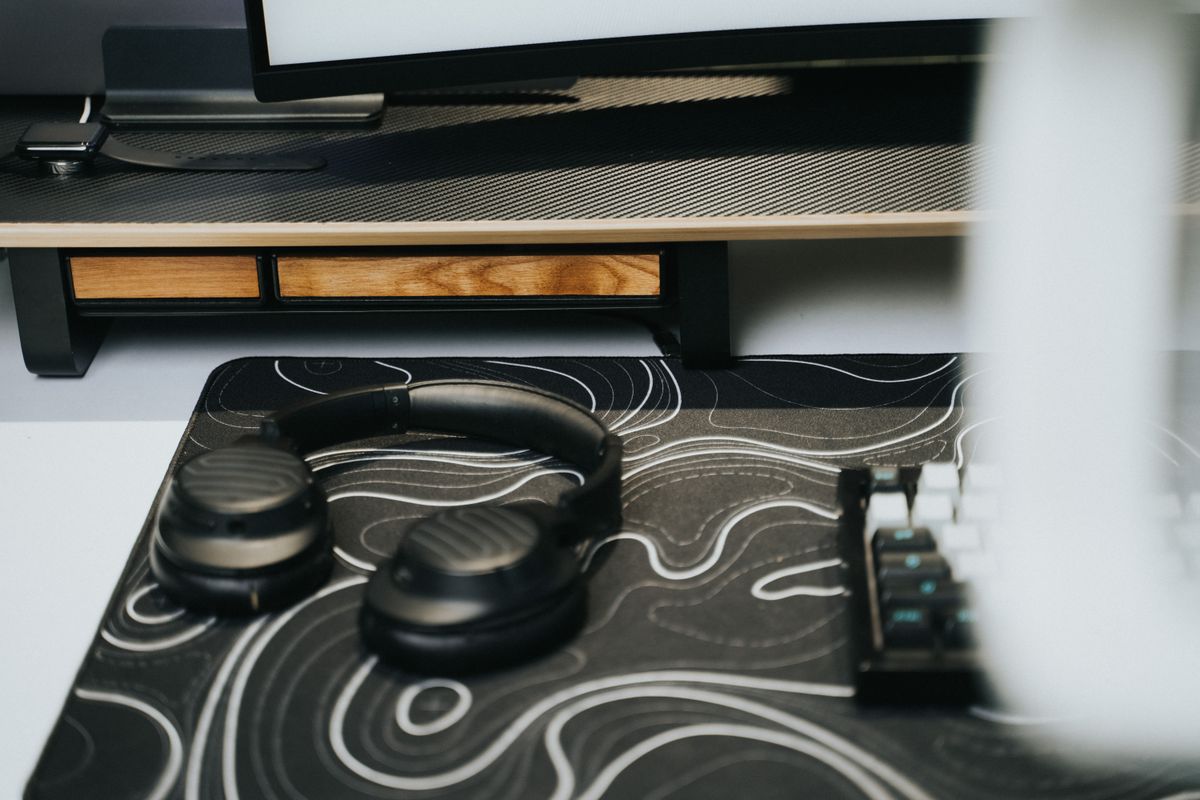
A desk pad can soften the feel of a hard tabletop, define a writing area and give a mouse a consistent surface. Those are different jobs. A thick cushioned mat that feels pleasant under a forearm may be too yielding for a fine pen, while a smooth writing pad may not suit a particular mouse sensor.
Start with the work that happens most often. If you write on single sheets, test how the pen behaves with the pad beneath them. If you mainly use a notebook, the notebook's own backing may matter more. For mouse use, check tracking across the actual material rather than assuming that every product described as a desk mat is a suitable mouse pad.
Size the clear area
Measure the space between the keyboard, monitor stand and the front edge of the desk. A large pad should lie flat without curling against equipment or hanging over the edge. If it must be moved whenever a notebook opens, a smaller writing pad may be more useful than a mat intended to cover nearly the entire surface.
Consider the edges. Raised stitching can be noticeable under a wrist or interfere with a sheet placed close to the boundary. A very thin pad may slide on a glossy desk. The backing should suit the tabletop finish without relying on adhesives that could damage it.
Cleaning is part of the choice
Read the care instructions for both the pad and the desk. Some materials tolerate a lightly damp cloth; others stain or react badly to cleaners. Do not assume a surface is heat-resistant because it is water-resistant. Keep hot equipment and drinks on suitable supports rather than treating the mat as universal protection.
Lift the pad periodically to remove trapped grit and check that moisture has not collected beneath it. A protective layer that traps abrasive particles can mark the finish it was intended to protect. Allow cleaned surfaces to dry before replacing it.
There is no need to cover the entire desk to make the work area feel finished. A pad earns its space when it improves a specific activity and remains easy to keep clean. If the desk already works well for both writing and pointing, leaving the surface clear is also a reasonable choice.